
My latest obsession - handmade ocarinas
-
Back in early December someone making a whistle made out of clay showed up in one of my social media feeds. I decided to give it a try - it’s much harder and more frustrating than it looked like in the tutorials - sculpting the sound making part is tricky, and in the beginning I felt lucky to get any sort of noise at all. But 3+ months later, I am getting the hang of it. Here’s the menagerie so far:
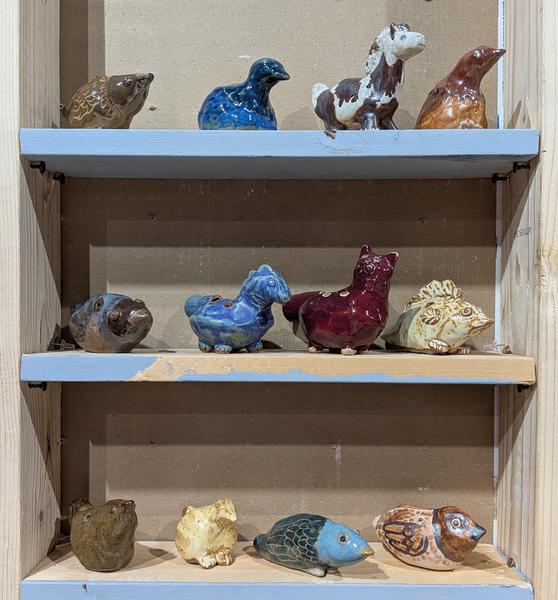 .
.I have started experimenting with my foraged clay pigments as glazes and underglazes on the studio clay, as well as using them for the clay body - the unglazed red ones are clays I’ve dug up nearby, the others have earth pigments I’ve found painted on them, a couple with studio glazes over the top:
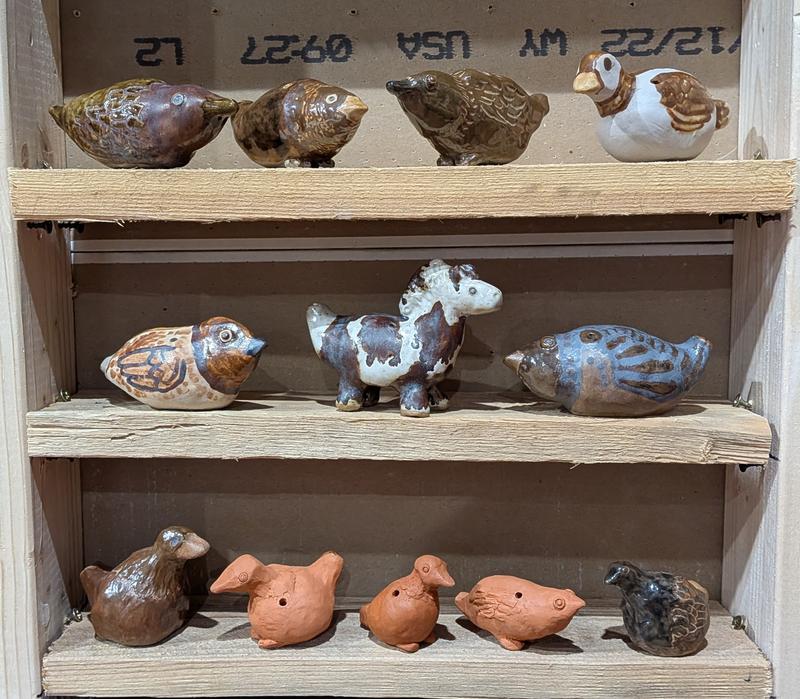
Some of them sound really good, some do not. Probably the nicest one is the little spotted horse. The larger the chamber, the lower the sound, and the less air you have to push through to get the sound. I put as many holes in as the ocarina can handle - as some point it quits making sound, and that seems to be dependent on the size of the window(compared to the size of the chamber) and how well I made the airway and the air splitting mechanism. “Helmholtz Resonator” is my new favorite name. I finally figured out how to make more notes out of fewer holes (YouTube is your friend) - finger hole size determines the pitch and a much larger hole next to a small one allows for 4 notes instead of 3 (by alternating which hole is open). So I’ve managed to make several that play an octave. Here’s what they sound like:
Link to video Link to video Link to video -
-
They shrink slightly in firing, so the pitch will raise a little. You form the body, and then noise making part. That gives you are bass note, then you punch one hole at a time - starting small - and you enlarge That hole until you get the next note you want (I usually go with a full step up, but not always). You then tune the next hole off the first hole, And so on. Sometimes I can only get one or two holes before it quits making noise. What fascinates me is that I end up with very close to the same bass note with a lot of them - even though I’m not trying to make the chamber the same size. Several of the small ones in the first video are the same starting note. And the two large ones in the last video start at very close to the same pitch.
-
-
-
-
You have the coolest hobbies!
-
Yes, wonderful, and cool hobby.
Your thread title had me chuckling 'latest obsession'.
I have to stop myself, from things like buying one of every instrument just to try, or David Winter vintage miniature houses.I particularly like the seal lower left on first photo.
-
Really cool, Jodi! I love your designs and they sound great. Move over, ukuleles!
Are you going to sell some of your creations?
-
-
I will eventually make enough to sell some of them in the gallery, I am currently too attached to the ones I have made so far to let them go! As in most things clay related (for me, anyway, as I love to hand decorate each piece) they are incredibly time consuming to make.
-
We unloaded the glaze kiln yesterday and a few more were fired. Here’s a video I made showing the difference in pitch after the firing - it went from close to an E major scale to an F#, so a whole step up. This was fired to cone 10 in the gas kiln, I can’t remember the exact shrinkage of this clay - somewhere around 12 - 14%. (Turn the sound up to hear the iPad video, then back down before I play at the end).
Link to video -
-
-
Some recent composer has an orchestral piece where the players put down their instruments and play ocarinas. I think Ligeti.
-
I bought a Japanese made plastic ocarina to try. I played the recorder and the clarinet when I was younger - The ocarina is a little trickier that those - two thumb holes and you use every finger to cover a hole (or two) - so the fingerings don’t feel intuitive (based on what I’m used to playing). Fun fact - Ennio Morricone used an ocarina in his music for The Good, the Bad and the Ugly.
-
-






Hello! It looks like you're interested in this conversation, but you don't have an account yet.
Getting fed up of having to scroll through the same posts each visit? When you register for an account, you'll always come back to exactly where you were before, and choose to be notified of new replies (either via email, or push notification). You'll also be able to save bookmarks and upvote posts to show your appreciation to other community members.
With your input, this post could be even better 💗
Register Login