
@RealPlayer Oh, no, RP. I'm sorry to hear that you are living with pain. Hope you find a good solution soon.
B
Bernard
@Bernard
Posts
-
Knee pain? Just walk it off. -
Word association threadRachel
-
Joined the Aeropress clubI have never heard of Aeropress so I just did a little googling. It looks like it uses a lot more coffee grounds than a French press. Is that so? I'm ready 2-3 tablespoons of grounds for one cup of coffee?
-
Gas clothes dryerAfter my experience with the LG washer I will never buy another of their products.
-
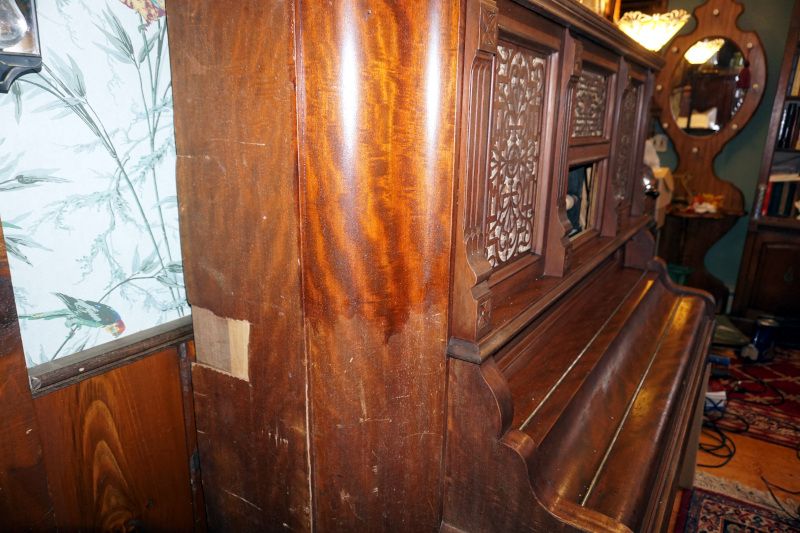
My latest projectThe difference between cleaned veneer and uncleaned. I'm about half way down the bentwood panel. This is nothing more than cleaning--no polishing, etc. I'm not sure if I will replace the entire end panel--on the left--or simply patch it. Same with the other end of the organ. I'm afraid new veneer might not match the old.
-
There goes Scaramucci's recordIt calculates to this:
1 Zacharia = .45 Scaramucci's
-
Word association thread -
Op 72. No 1.Very nice, Mark. Very sensitively played. Your piano sounds so nice, what brand is it?
-
Music is wonderful@ShiroKuro A somewhat irreverent singing "comedian". Not my cup of tea. His schtick gets old rather quickly.
-
Word association thread -
So, how weird are you??Does anyone here have two acoustic pianos?
I don't but my piano tuner, from whom I purchased the Aeolian organ, said he has 15 pianos in his house!! I imagine most of them have had the legs removed and they are stacked, standing on their keyboards. He also had several grands in the storage barn where I went to look at the organ.
-
Word association threadEncore
-
Word association thread -
CaptchasIn related news. Glad I have eschewed "smart" appliances. I worry about the car though.
AI in your oven? Anthropic warns models ‘months away’ from self-replication on smart devices
IMO, if you build anything this sinister your ass should be hauled off to court. It breaks many human laws.
-
CaptchasYou’ll probably be more pissed when you discover (if you didn’t know) that every time you do a captcha you’ve been training google’s self driving car software (Waymo).
I knew that.
It was a good solution before AI came on the scene. But it is no longer viable and not everyone is benefiting. I've been reading that people are now abandoning pages because the captchas are so impossible. Sales lost, websites losing traffic. Captchas no longer work, these latest horrors are outrageous. My recent experience bears this out. I was this close to quitting eBay because I kept getting unclear captchas with blurry images, some of which make no sense. It's ridiculous.
Bring back captchas that humans can understand and abolish AI.
-
CaptchasHave you encountered any Captchas lately? Holy @(#%, they are impossible. The images are all blurry, the instructions nebulous, the meaning impossible to decipher. What an exercise in frustration.
Why do we humans have to go through this abuse? Because AI can now recognize and solve captchas. So we, the people, have to jump hoops for the sake of a #*$&% pile of rubbish machinery.
-
Where (and how) to frame this?I would never go after anyone for having knick knacks. I think I read that Beethoven loved pretty little objets.
-
Where (and how) to frame this?@ShiroKuro Oh, I didn't realize there was a gold border. A mat would cover that up. Maybe mount it on a background with a plain black frame?
-
Where (and how) to frame this?@ShiroKuro I see them now SK.

A plain black frame, like you have on the other art works, no mat.
-
Where (and how) to frame this?I can't see any of the images and postimage hangs up.