Cool beans!
We don't watch baseball much at all but we are all in for the Brewers! Milwaukee is just next door...
 W
W
Cool beans!
We don't watch baseball much at all but we are all in for the Brewers! Milwaukee is just next door...
Actor Walter Koenig, who played Ensign Pavel Chekov, the youthful Russian navigator on the “ Star Trek ” television series and several movies, has died. He was 90.
Koenig died Monday at his home in the North Hollywood neighborhood of Los Angeles, talent agent Zachery McGinnis said in a statement.
Koenig’s death leaves William Shatner, who played Capt. James T. Kirk, and Takei as the only surviving members of the original series’ main cast. Leonard Nimoy, Nichelle Nichols, James Doohan and DeForest Kelley, who played Spock, Uhura, Scotty and Dr. Leonard “Bones” McCoy, have died.
https://apnews.com/article/walter-koenig-dies-ad6aed51fc41417a8812bffccec1393c
‘It’s magic’: scientists rediscover how to make ancient Roman colour-changing glass
Exclusive: Optical engineering that went into 1,600-year-old Lycurgus Cup has baffled experts for centuries
The BBC article linked to this World in Data article. Bunch of interesting charts re energy generation sources.
After defying projections, solar's dramatic growth means it is now overtaking nuclear as a global power source. Here are seven reasons for solar's success, and where it might go from here.
The world's solar power is crossing a threshold. A decade ago, it barely registered on a global scale, providing just 1% of the world's power. In 2026, it will almost certainly increase to 10% of power, and overtake nuclear, a mainstay of electricity since the late 1970s.
Globally, solar electricity generation quietly overtook nuclear power (just) in 2025, according to statistics from UK-based energy think tank Ember. And BBC analysis of Ember data over the past 12 months up to September 2026 shows it clearly outstripping nuclear, producing 13% more power.
"[Solar] generating more electricity than all the world's nuclear power plants is a pretty insane stat, for sure," says Dave Jones, co-founder of Ember.
From China's vast arrays to a recent solar upsurge driven by escalating oil prices, the incredible rise of solar power has defied all projections. Here are seven ways it has become an apparently "unstoppable force" – and what the future looks like from here.
https://www.bbc.com/future/article/20261023-how-solar-became-bigger-than-nuclear
Obama in Cleveland.
Link to videoOn Monday, Nov. 27, 1961, four Pitt students sat down to play a game of Monopoly. By the time they stopped, they had made a mark on the history of the iconic game that stands to this day.
The record for the longest Monopoly marathon ever played was set here at Pitt in 1961, when brothers from the Sigma Alpha Mu fraternity played for five days straight.
On Wednesday, the game ran into trouble. As anyone who’s even brushed with Monopoly will be aware, a player receives $200 every time he or she passes the space “Go.” The Sigma Alpha Mu brothers had passed “Go” so many times by this point that their bank had run out of money. So naturally, the players wired Parker Brothers, the makers of Monopoly, to suggest a course of action.
As recorded in The Pitt News story about the debacle, the coverage of the game in the Sigma Alpha Mu fraternity magazine, and the current directions to Monopoly itself, Parker Brothers did not let this stand. Upon receiving the message of the marathon gamers’ distress, Parker Brothers President Robert Barton wired them back.
“Refuse to let bank fail. Rushing one million Monopoly dollars to you by airmail — carry on.”
According to The Pitt News story from 1961, the brothers loaned back some of their Monopoly money to the bank so they could continue playing while the reserve funds were being flown to Pittsburgh International Airport.
The $1 million in Monopoly money was picked up at the airport by Brink’s Security armored trucks and driven to the fraternity house, arriving on Thursday night, by which time the brothers had broken the bank again.
At this point, the story was picked up by major news outlets across the country, including The Wall Street Journal. According to Leeds, the Journal thought the game was an excellent representation of inflation.
The story from the Sigma Alpha Mu magazine reported that, “Several economics professors suggested their students watch the game and see how the value of money can be deflated when too much of it is in circulation.”
“That’s how a story went viral in those days,” Leeds said.
https://pittnews.com/article/13293/archives/225-way-past-go-the-marathon-monopoly-game/
A Texas Cop Signed on to Help ICE Deport His Neighbors. It Tore the Town Apart.
Reporting Highlights
The Shadow Surge: In January 2025, President Donald Trump revived a troubled ICE program that deputizes cops as deportation officers. Over 29,000 local officers nationwide have enlisted.
After the Flood: Ingram, Texas, was rebuilding from a historic flood when its Police Department signed on with ICE. Within a year, cops would hand over the equivalent of 10% of the town.
Cop on the Ground: The local face of the national immigration crackdown became Officer Jaron Alexander. After suggesting ICE’s program to his chief, he grapples daily with the consequences.
https://www.propublica.org/article/deportations-ingram-texas-287g-jaron-alexander
@mark What a sweetie. Tibetan terrier, right?
Jared Kushner is pushing back on a report involving a hacked iPhone, international spies and billion-dollar transfers from foreign governments.
An upcoming book by journalist Matthew Cole claims Kushner, who is President Trump's son-in-law, had access to more than $2 billion in "slush money funds" from Middle Eastern leaders in an attempt to influence U.S. foreign policy.
An excerpt of the book released Thursday details allegations encompassing Kushner's time as a senior White House adviser during the first Trump administration, which included a lead role in U.S. policy in the Middle East. Kushner had a major hand in negotiating key foreign policy deals that involved Israel, the Gulf states, China and Russia during that period.
https://www.yahoo.com/news/politics/articles/kushner-pushes-back-report-involving-133251393.html
Here's the Vanity Fair excerpt from the book. Subscription required.
https://www.vanityfair.com/story/jared-kushner-hacked-phone-secret-negotiations
Link to videoI expect the fight to begin November 4.
Maybe earlier.
President Donald Trump on Friday said he personally directed the Department of Justice to file a lawsuit seeking to prevent Alaska from certifying its Senate election results if Republicans lose.
“I’m the one that said do it,” the president told reporters shortly after landing in Florida.
The president’s admission comes a day after DOJ sued Alaska election officials, arguing that the presence of an independent candidate named Dan Sullivan in addition to the incumbent Sen. Dan Sullivan on the ballot could confuse voters and cost the party the race against Democratic Rep. Mary Peltola. It’s one of a handful of races seen as key to maintaining GOP control of the Senate.
The lawsuit marks an extraordinary intervention by the federal government in a state election, with the administration seeking to delay certification of results if the incumbent loses by a margin small enough that votes cast for the independent Sullivan could have changed the outcome.
“Given the substantial likelihood that the inclusion of Daniel J. Sullivan will confuse or mislead voters looking to cast a vote for Senator Sullivan, and thus distort the will of Alaskan voters, there is a substantial likelihood that a certification of the election will reflect an electoral process that lacked integrity,” DOJ wrote in its complaint.
The Alaska Supreme Court in June ruled that the independent Sullivan could remain on the ballot, but Trump continued to rail against his candidacy and the state’s election rules.
No wonder he referred to them as "my DOJ" a couple of days ago....
Sweet!
Better hurry, @steve-miller ... says it's almost sold out....
Oh, wow! Stunning! Gorgeous! Magnificent!
I bet you bought some yarn....
DeWine has always been a decent guy.
Sadly, Vance and Trump are piling up the disgusting points....
https://www.theguardian.com/us-news/2026/oct/22/ramaswamy-attack-ad-ohio-dewine
And the diagnoses are in....the freezer is a seized compressor, so it's a goner.
Dryer is suffering from arthritis of the rollers and an ancient belt. Worth repairing; he has those parts on the truck. We don't want one of those newfangled electronic wifi dryers....
edit: He didn't charge for diagnosing the dead freezer; it only took him five minutes.
For more than a decade, serious flaws had gone undetected in the technology underpinning much of the internet.
It took AI to bring them to light and caused a global cyber-security alert.
The vulnerabilities lie within a programming language called PHP, which has been used internationally since the 2000s to build websites.
Governments and cyber-security agencies around the world are scrambling to contain the fallout of the discovery on Wednesday, and have urged website operators to install a new emergency fix or consider taking their platforms offline.
Cyber-security firm Wiz - one of the companies whose researchers uncovered the vulnerabilities - described the flaws as the "most severe" ever detected by AI.
OpenAI, whose technology was used to find the flaws, called the discovery "one of the most impactful security issues in recent memory".
I find the same thing. I used to love going on cold winter hikes. Janet was always cold and I was always hot. We've completely reversed.
Same here. In his much younger youth Mr wtg wore a t-shirt and shorts in the middle of winter and I was bundled in wool sweaters. As reverse puberty hit me I shed the sweaters and he switched to sweat pants. There was a point when we were in our late 40s/early 50s when a single thermostat setting met both our needs. Our winter setting is 70; summer setting is 76. We used to let the nighttime setting for the furnace drop to 68, but since his stroke Mr wtg tends to get cold at night so we just leave it at 70.
PIcked up this variety pack of olives a couple of weeks ago at my third place. 
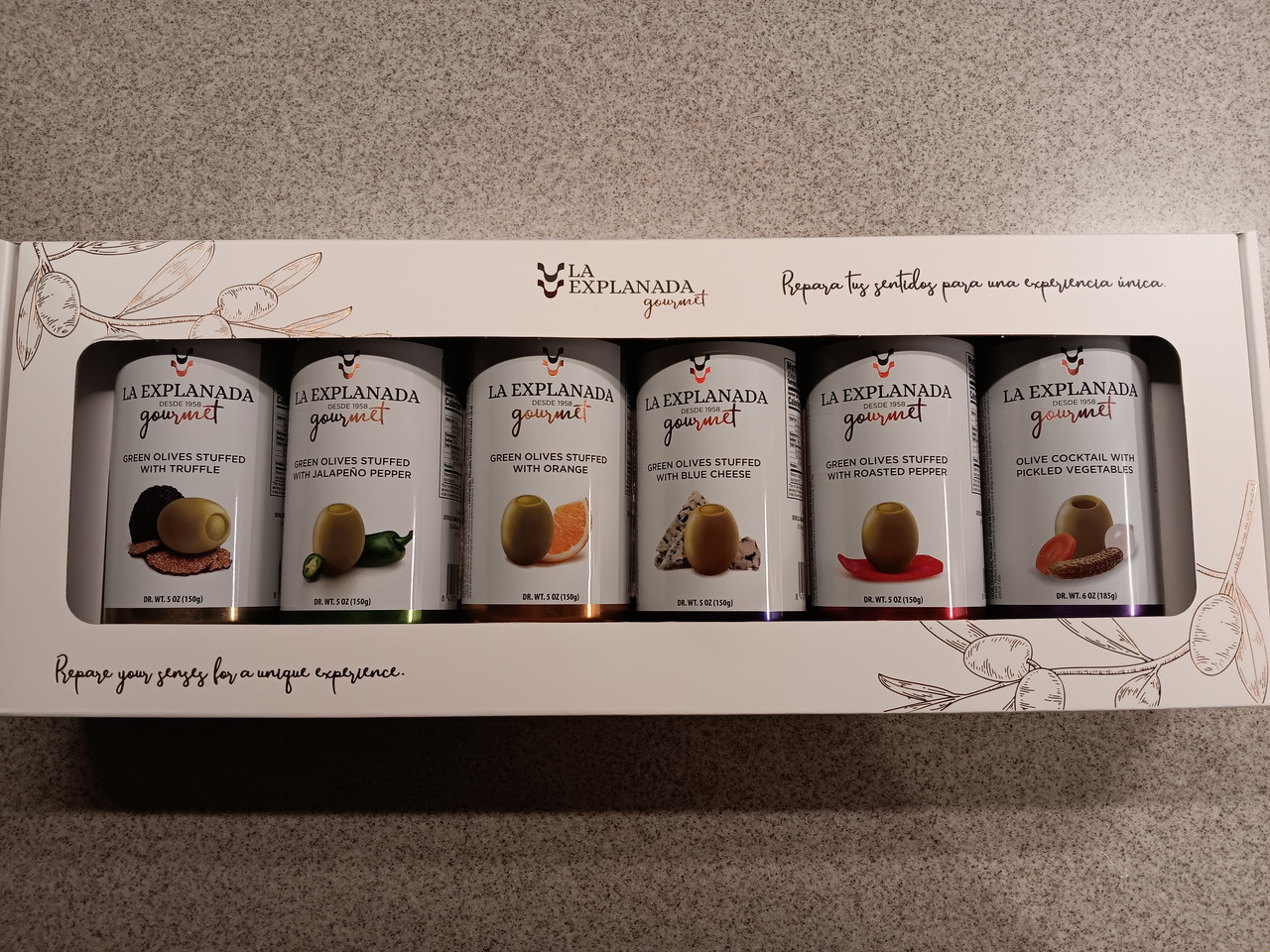
Tried one of them (the olives and pickled vegetables) and it got the wtg seal of approval. Looking forward to trying the rest. Mr wtg isn't a fan of truffles or blue cheese, so I'll get to eat all of those....